Sally, the $57,590 robot arriving at a rural high school in New York (and not here to replace anyone)
🕒 Published on Zendoric: July 21, 2026 · 00:20
✨ AI-generated · how it's made
A small school district in western New York, on Seneca Nation land, will introduce a humanoid robot from Realbotix into its AI and robotics classes this fall. The superintendent himself rushes to clarify the obvious: it doesn't replace any teacher. The case, modest in scale, is a good gauge of how AI is really entering the classroom.
📚 Go deeper
How opaque algorithms decide who gets credit, a job or parole — and why they tend to punish the same people.
As an Amazon Associate, Zendoric earns from qualifying purchases; the price does not change for you. · all our recommended books →
By NewsNation · July 20, 2026.
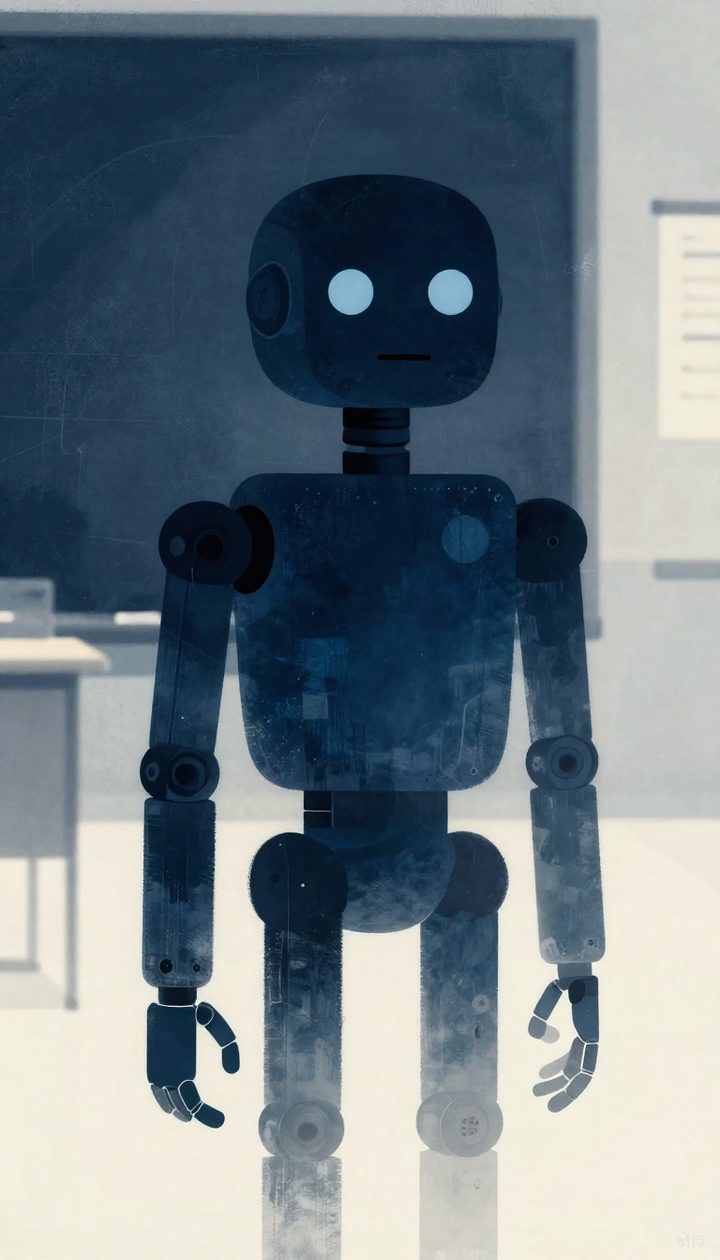
The Salamanca City Central school district, a rural area of western New York located on Seneca Nation land, will deploy a humanoid robot at its high school this fall. It's called "Sally," manufactured by Canadian company Realbotix, and its cost, according to the contract cited by New York Focus and picked up by NewsNation, is $57,590. It will start in Salamanca High School's AI and robotics classes, alongside an AI assistant program in which students interact with the robot's avatar from their own laptops.
Superintendent Mark Beehler has moved to shut down any alarmist reading: "there is absolutely no intention of replacing teachers," he stated, stressing that "human interaction is enormously important for young people's development." The pilot begins only with upper-grade students, and its expansion to other levels will depend on how it works out, according to Beehler himself.
The cost figure deserves context: $57,590 is, generally speaking, less than what a single teacher's annual salary costs in the United States. In other words, the district isn't buying an alternative to its teachers, but rather a one-off teaching resource, the size of an expensive digital whiteboard, not a staff position. And it's telling that students' actual interaction happens, for the most part, through an avatar on the laptop screen: the humanoid body works mainly as an attention-grabber and motivator, not as the main teaching channel.
There's another detail that carries more weight than it seems: the district says it collaborated directly with Realbotix to build what Beehler calls a "safe AI platform," precisely to avoid the risks he attributes to "other open AI sources." This is the same logic we're seeing in companies and administrations: when generative AI enters an environment with minors, the value isn't in the most powerful model but in the most restricted and auditable one. A school doesn't need the market's most capable chatbot; it needs one that doesn't stray from the script.
This connects with something we've already argued when analyzing AI's impact on educational employment: the winner in this sector isn't the machine, but the teacher who learns to orchestrate it. The program's own stated goal —teaching students "to use artificial intelligence appropriately" in high school and later at work— isn't a side effect, it's the real product. Humanoid robotics here is the flashy wrapping; the actual content is AI literacy with guardrails.
Our reading is that these kinds of small, highly localized pilots say more about the direction of change than about its magnitude. No curriculum has been replaced, there are no layoffs, there's no evidence yet of improved learning: the rollout begins this fall and there's no outcome data. What there is, however, is a clear trend: schools, even the smallest and least well-resourced ones, are starting to experiment with physical forms of AI in the classroom, and doing so with deliberate caution —starting with upper grades, with a vendor hand-picked for its control over the system— rather than diving in all at once.
In the long run, this caution is what separates the path toward abundance from the path toward chaos: AI in schools only frees up teachers' time for what truly matters —human connection, judgment, mentorship— if it's implemented as a governed tool rather than a cheap substitute. That a rural district with a tight budget is investing in doing it right from the start is a more encouraging sign than a worrying one. What remains to be seen is whether Realbotix can make the promise survive the first real year in the classroom, with flesh-and-blood children rather than a press release.
📚 Go deeper
The best starting book if you're not technical: a Wharton professor explains how to work WITH AI — when to delegate, when to supervise, when to keep i

AI as the latest chapter in the history of information networks, from gossip to the printing press to the algorithm.
As an Amazon Associate, Zendoric earns from qualifying purchases; the price does not change for you. · all our recommended books →
🔗 Related on Zendoric
- New York pauses 'Sally', its AI robot teacher: the failure is not the technology, but trust · 2026-07-29
- New York stopped robot teacher 'Sally' in 24 hours: journalism did it, not the law · 2026-07-28
- A NY School Bought a $58K Classroom Robot From a Sex-Doll Maker. The Real Story Is Procurement. · 2026-07-19