Nvidia sends its Jetson chips to the Moon aboard Lunar Outpost's rover
🕒 Published on Zendoric: July 25, 2026 · 00:23
✨ AI-generated · how it's made
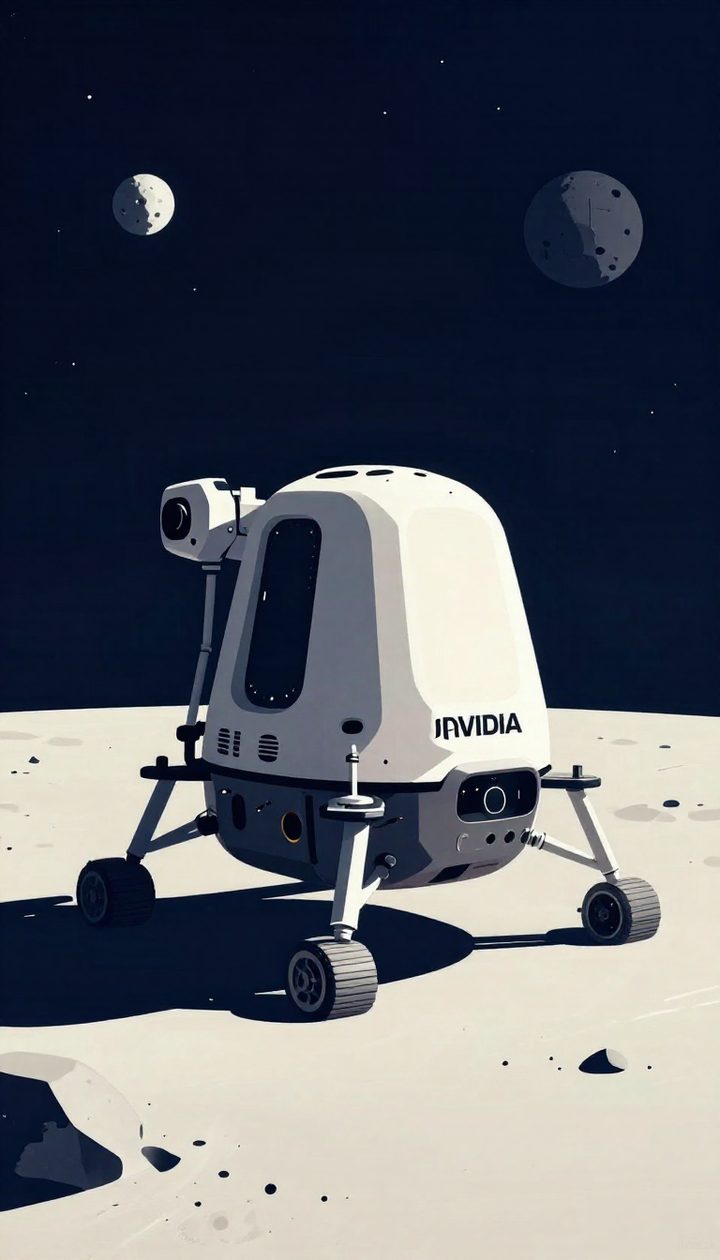
Lunar Outpost, a startup building robotics for space infrastructure, has announced that its next lunar rover will use Nvidia's Jetson chips to control its lidar system. If the mission goes ahead as planned, it will be the first time a GPU reaches the Moon's surface.
📚 Go deeper

The story of NVIDIA and Jensen Huang: how a video-game card company ended up making the most coveted resource on the planet.
As an Amazon Associate, Zendoric earns from qualifying purchases; the price does not change for you. · all our recommended books →
Lunar Outpost, a startup dedicated to building robotics for space infrastructure, has announced that its next lunar rover will use Nvidia's Jetson chips to control its lidar system. If the mission goes ahead as planned, it will be the first time a GPU reaches the surface of the Moon. According to Justin Cyrus, CEO of Lunar Outpost, the company is comparing the Jetson with its usual flight compute platform, which has a longer track record in space missions, to weigh the advantages and drawbacks before deciding to adopt more powerful GPU systems in such extreme environments.
This move is part of a broader context: NASA has launched a program to pay private companies to explore the lunar surface ahead of its plans to return astronauts to the Moon, possibly as early as 2028. The program is inspired by the collaboration model the agency maintains with SpaceX, and seeks to have technology companies develop vehicles capable of carrying scientific sensors to study the lunar terrain and search for resources, such as water, that could prove useful or even profitable to exploit.
Nvidia, for its part, has also recently announced a partnership with Firefly Aerospace—the first private company to successfully land a robot on the Moon—to have the Jetson platform operate aboard a satellite in lunar orbit tasked with processing images. That satellite aims to gather data for scientists working on mapping the Moon, in addition to tracking the growing number of robots operating on its surface.
Lunar Outpost's next rover will travel integrated into a lander built by Intuitive Machines, another company focused on lunar technology. This vehicle is designed to venture into craters and other areas that are difficult to explore from orbit. A later mission will head to Reiner Gamma, a region of the lunar surface where a magnetic anomaly has long intrigued scientists. Both missions are scheduled to launch aboard a Falcon 9 rocket before the year is out.
Nvidia's Jetson platform does not enjoy the same prominence as other AI-oriented products from the company, such as Blackwell or Vera Rubin, but it plays a key role in numerous physical AI systems. Designed to be compact and energy-efficient, it allows robotic systems to process their sensor signals locally, so that they can understand and react to their surroundings more quickly. Cyrus explained that the company's autonomy stack was more deterministic five years ago, and that it now combines deterministic methods with physical AI, running both approaches in parallel to identify where physical AI can add new capabilities.
Using GPUs in space poses significant challenges because of the extreme nature of the environment. Most GPUs operating in space do so in orbits close to Earth, where they are relatively protected from radiation and abrupt temperature changes. The Moon, by contrast, is far more exposed to cosmic radiation and thermal swings as it moves through its phases. Cyrus stressed that any system must be able to survive the lunar night operating on very little power.
NASA has far-reaching ambitions to achieve a sustained human presence on the Moon, something that will foreseeably require autonomous systems to pave the way and take on much of the heavy lifting. Cyrus noted that Lunar Outpost's goal is to move from exploration to permanence, building a true outpost on the Moon, and that combining deterministic models with a physical AI layer is what will make it possible to sustain a human presence in space, with a genuine robotic workforce.
Over the coming years, Lunar Outpost plans to launch several smaller autonomous rovers, as well as a larger one, called Pegasus, conceived to carry astronauts. The latter depends on a rocket built by Blue Origin, Jeff Bezos's space company, which suffered an anomaly this summer and whose return to flight still has no clear date. Cyrus indicated that, based on the information Lunar Outpost has, Blue Origin appears to be making adequate progress on the launch platform, though he cannot comment on the exact timelines of the company itself or of NASA for rebuilding that platform, and that, as far as they know, they remain aligned with the 2028 target.
Overall, the article makes clear that both the futuristic visions of space data centers and those of fleets of robots working on the Moon ultimately depend on a single factor: the availability of higher-capacity rockets.
📚 Go deeper

Semiconductors as the oil of the 21st century: history, espionage, and why an island of 23 million people underpins the entire AI economy.

The memoir of the creator of ImageNet, the scientist who made the deep learning revolution in vision possible.
As an Amazon Associate, Zendoric earns from qualifying purchases; the price does not change for you. · all our recommended books →
🔗 Related on Zendoric
- HPE will take its Spaceborne Computer-4 to the Moon with AI and HPC aboard Astrolab's FLIP rover · 2026-10-22
- Anthropic seeks its own chip: the race to not depend on Nvidia reaches another major AI lab · 2026-07-03
- VB Pulse survey: enterprises put non-Nvidia chips 14 points ahead of Nvidia's next GPU · 2026-09-08