AMD puts its Helios AI servers into production to take on Nvidia
🕒 Published on Zendoric: July 25, 2026 · 00:23
✨ AI-generated · how it's made
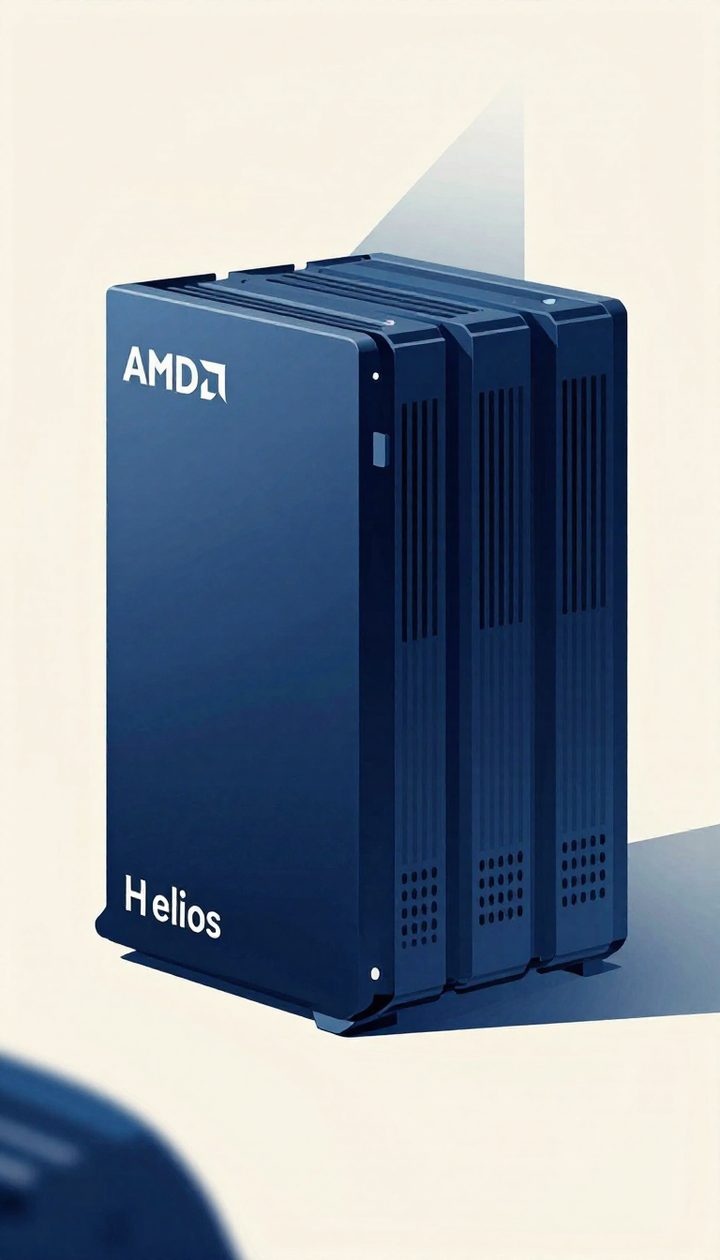
AMD has confirmed that its second-generation artificial intelligence servers, dubbed Helios, are now in full production and will begin shipping to customers late in the third quarter.
📚 Go deeper
The definitive piece of investigative journalism on OpenAI: 260+ interviews, the clash between safety and speed, and the attempted firing of Sam Altma
As an Amazon Associate, Zendoric earns from qualifying purchases; the price does not change for you. · all our recommended books →
AMD has confirmed that its second generation of artificial intelligence servers, dubbed Helios, is now in full production and will begin shipping to customers late in the third quarter. The announcement was made by CEO Lisa Su during a conference in San Francisco, at an event attended by hundreds of executives and engineers from the sector. According to Su, "customer demand for Helios is extremely strong," and with this product the company is seeking to claw market share away from Nvidia, especially in the inference segment—that is, the processing that occurs when a user interacts with a chatbot like ChatGPT.
Helios servers incorporate AMD's new MI455X AI accelerator alongside its Venice central processor, both manufactured by TSMC (Taiwan Semiconductor Manufacturing Co.). This is AMD's most ambitious bid to date to compete in the large-scale ("scale-up") compute segment, a field historically dominated by Nvidia. Asked at a press conference whether the company was content with second place in the market, Su was emphatic: "We're taking another major leap forward. We really believe we'll have the leadership in the large-scale compute domain."
One of the most significant moments of the event was the presence of Sachin Katti, OpenAI's vice president of compute strategy, who took the stage alongside Su to confirm that the maker of ChatGPT will deploy Helios "at a massive scale" starting late this year, accelerating that rollout throughout 2027. Katti added that OpenAI also plans to use AMD's next-generation MI500 chips. This collaboration is part of the multi-year agreement the two companies sealed in October, which has been reported to bring AMD tens of billions of dollars in annual revenue and which gives OpenAI the option to buy up to roughly 10% of the chipmaker.
The other major partner mentioned was Anthropic. On the Wednesday before the event, AMD had announced plans to sell it up to two gigawatts of its Instinct MI450 chips starting in the first half of 2027, a deal that also includes an investment of up to 5 billion dollars in the maker of Claude. Tom Brown, co-founder of Anthropic, joined Su on stage to explain that Claude had been able to configure AMD's AI servers on its own in a single weekend, stating that "anyone, human or AI, can now build real models on this platform." Su clarified at the press conference that she expects Anthropic to consume AMD chips mainly through cloud computing partners and, potentially, through its own data centers, and that the partnership is also focused on helping developers build software with Claude on AMD infrastructure.
AMD also revealed an alliance with Cerebras Systems: its CEO, Andrew Feldman, took the stage to announce that the two companies will combine their AI servers, first within Cerebras's own data centers. During the trading session, Cerebras shares rose about 5%, while AMD's fell nearly 2%; according to Jacob Bourne, an analyst at Emarketer, that decline had more to do with generalized weakness in the U.S. stock market and a massive sell-off of semiconductor stocks than with any specific rejection of the Helios announcement.
On the market-projection front, Su explained that AMD estimates the total computing market will reach 2 trillion dollars in 2030, of which 1.4 trillion would correspond to chips that accelerate AI and 220 billion to central processors (CPUs), a field in which AMD has long competed with Intel and which Nvidia has now also entered. For reference, the total computing market was estimated at 365 billion dollars in 2025. "There isn't a single company that can solve it all," Su summed up, in a message meant to underscore that the pie is big enough for several players.
AMD's announcement comes just as Nvidia, this very week, released technical details of its new Vera CPU, which, combined with its Rubin GPU, would seek to maximize the work AI agents can perform for every unit of electricity consumed—a message centered on energy efficiency as a differentiator against AMD's offering. During the San Francisco event, AMD showcased its Helios data rack alongside booths from cloud computing providers such as Vultr and TensorWave, both with data centers already running on AMD hardware.
Taken together, the day leaves an increasingly clear map of the alliances that will define the next stage of AI infrastructure: AMD securing high-volume commitments from OpenAI and Anthropic, two of the most important generative AI labs, while trying to position Helios as a credible—not merely complementary—alternative to Nvidia's platforms in the large-scale compute segment.
📚 Go deeper
The story of NVIDIA and Jensen Huang: how a video-game card company ended up making the most coveted resource on the planet.
The reference manual for building products on top of AI models: prompts, RAG, fine-tuning, agents, evaluation and deployment.
As an Amazon Associate, Zendoric earns from qualifying purchases; the price does not change for you. · all our recommended books →
🔗 Related on Zendoric
- Netflix reveals about 300 productions used generative AI in 2026, according to its earnings report · 2026-07-21
- JPMorgan blocks third-party AI agents such as Muse and Instinct from directly accessing customer accounts · 2026-10-16
- Amazon cuts jobs in its own general AI division: not even those building it escape the adjustment · 2026-07-23