Chinese models like Kimi K3 and Qwen: why the race is about costs, not capabilities

🕒 Published on Zendoric: July 23, 2026 · 00:24
✨ AI-generated · how it's made
Ben Thompson's article in Stratechery starts from a personal anecdote from his time at the Kellogg School of Management to lay out a central thesis: in the AI industry the classic economic principles —marginal costs, commodity markets, cost structure— are making a strong comeback, which…
📚 Go deeper

Semiconductors as the oil of the 21st century: history, espionage, and why an island of 23 million people underpins the entire AI economy.
As an Amazon Associate, Zendoric earns from qualifying purchases; the price does not change for you. · all our recommended books →
Ben Thompson's article in Stratechery starts from a personal anecdote about his time at the Kellogg School of Management to lay out a central thesis: in the AI industry, classical economic principles —marginal costs, commodity markets, cost structure— are making a forceful comeback after zero-marginal-cost software had long pushed them into the background. The immediate trigger is the release of Kimi K3, a Chinese open-weights model from Moonshot AI that approaches the state of the art and that set off an intense discussion about whether China is closing the capabilities gap with Western labs.
The first technical-economic argument Thompson develops is the distinction between R&D (fixed spending, independent of revenue) and COGS (cost of goods sold, which does scale with usage). The common confusion is to think that open-weights models are "free": what is free is the R&D savings from not having to train the model from scratch, but serving inference still costs real money and that cost grows with revenue. As a concrete example, he notes that Kimi K3 costs $3 per million input tokens and $15 per million output tokens, versus $5 and $30 for Sol, which on the face of it makes Kimi cheaper, but the author himself qualifies that this may not even be the right metric.
Here comes the second argument: the difference between tokens and intelligence. Picking up Jensen Huang's (Nvidia) idea of "token factories," Thompson explains that this metric made sense in the first era of AI (chatbots that delivered tokens directly to the user), but it loses validity in the reasoning era, where the number of chain-of-thought tokens needed to reach a correct answer varies greatly between models. According to the article, Kimi would need many more tokens than Sol to reach equivalent results, which in practice would cancel out its nominal price advantage. The conclusion is that tokens are not a homogeneous product (commodity): what is fungible is intelligence —the final correct answer— not the tokens used to produce it. The real cost of that intelligence depends on factors such as the model's footprint, inference efficiency (mixture-of-experts-type architectures), memory efficiency (KV cache), serving efficiency (batching, scheduling, prefix caching) and the efficiency of the tokens needed to get it right.
From there, Thompson devotes a section to explaining the mechanics of commodity markets in order to apply them to AI: in a commodity market everyone charges the same price, set by the provider with the highest marginal cost needed to satisfy demand; the most efficient providers earn a margin, and the least efficient one sells at marginal cost (or goes bankrupt) as long as it fails to adjust its capacity. The article develops a numerical example with three hypothetical providers (A, B and C) with different production costs to illustrate how revenue and margins are distributed according to demand and price elasticity, and how fixed costs (R&D, debt) can drive a provider into bankruptcy even if the market works "correctly."
Applying that logic to AI, Thompson argues that these commodity dynamics do not yet hold today because demand for frontier models far exceeds supply, which is limited by the scarcity of compute capacity. That scarcity benefits the entire chain: Nvidia earns high margins selling chips, its customers (he mentions SpaceXAI as an example) resell that capacity at a margin to companies like Anthropic, and the latter can in turn afford to pay that premium because it resells tokens at an even higher margin. Moreover, Anthropic and OpenAI would have, according to the author, some of the lowest costs per unit of frontier intelligence thanks to their serving scale and token efficiency, and they serve models of a certain capability level with months of lead over the competition, time they use to optimize costs. Market demand, he stresses, still does not treat intelligence as a commodity: people specifically ask for Anthropic or OpenAI, not any equivalent model (which is why SpaceXAI or Meta sell excess capacity to Anthropic instead of competing with their own models). The conclusion of this section is that the panicked reaction to Kimi and the Chinese models is, in his view, overblown from an economic standpoint: what looks like a cheaper price for the Chinese models would actually be a reflection of the "price umbrella" created by the current scarcity of compute in the West, not necessarily a lower marginal serving cost in China.
The next section explores why, then, the frontier labs seem so worried. Thompson offers four reasons. First, they would be mentally anchored to an earlier stage in which training consumed more compute than inference, which forced them to maximize inference revenue to fund the next training run; going forward, he expects the inference market to grow much faster than training costs, allowing lower prices to be offset by volume, something that just eight months ago was unclear but that the rise of AI agents would make more viable. Second, intelligence is not a perfect commodity because whoever runs inference also collects data that feeds back into the next version of the model, which explains both the labs' interest in lowering prices and increasing usage and the obsession of companies like Microsoft with helping their customers run their own models (something far more viable if the Chinese models are a real alternative). Third, frontier labs seek to differentiate themselves by integrating vertically into the user experience: the article notes how "sticky" tools like Claude Code and Codex are, so that whoever starts working with a given environment tends to stay in it, a dynamic that will intensify among non-technical users; in the long run this poses a threat to software providers like Microsoft, although the latter could hold out if they have access to their own competitive models. Fourth and last, Thompson points to the ideological component, particularly of Anthropic, whose view that only it can be a "trusted steward" of AI is dealt a mortal blow by the existence of open-weights alternatives.
A specific section analyzes the Chinese motivation behind these releases, drawing on a Bloomberg quote: Alibaba launched a preview of Qwen3.8 Max (2.4 trillion parameters), described as "second only to Anthropic's Fable 5," just days after Moonshot unveiled Kimi K3 (2.8 trillion parameters), a release that generated such demand that Moonshot had to temporarily pause new subscriptions. It is significant, the author notes, that Alibaba —which had stopped publishing the weights of its most advanced models earlier this year— is going to make Qwen3.8 Max open again, something Thompson links to a recent speech by Xi Jinping in which he reaffirmed the commitment to openness and open source in AI as an engine of global economic growth, with the emphasis on AI moving "from the digital world to the physical world" (a terrain where China leads in areas such as robotics). The strategic reading Thompson makes is clear: China seeks to "commoditize its complements" —weakening the position of the U.S. frontier labs while simultaneously strengthening any potential U.S. adversary through an open ecosystem— and to prevent the United States from gaining an asymmetric advantage in AI.
The article closes with sections on distillation (the use of a more powerful model as a "teacher" to train one's own more cheaply). Thompson argues that it would be a mistake to attribute all the success of the Chinese labs to distillation of Western models, but it would also be a mistake to ignore it: it has become especially relevant as post-training reinforcement learning (post-training RL) gains weight, since it allows Chinese labs to use frontier models as "teachers" instead of building reinforcement environments from scratch, achieving rapid improvements at lower cost. He cites an analysis by Dean Meyer and Konstantine Buhler arguing that this gives Chinese open models a recurring structural advantage over Western open models, which are bound by the frontier labs' terms of service not to distill them directly, so they end up distilling secondhand, via Chinese models. Thompson then poses a rhetorical question: if the frontier models themselves are nothing but a distillation of all the knowledge available on the internet, in what sense is distillation a problem?
📚 Go deeper

The story of NVIDIA and Jensen Huang: how a video-game card company ended up making the most coveted resource on the planet.
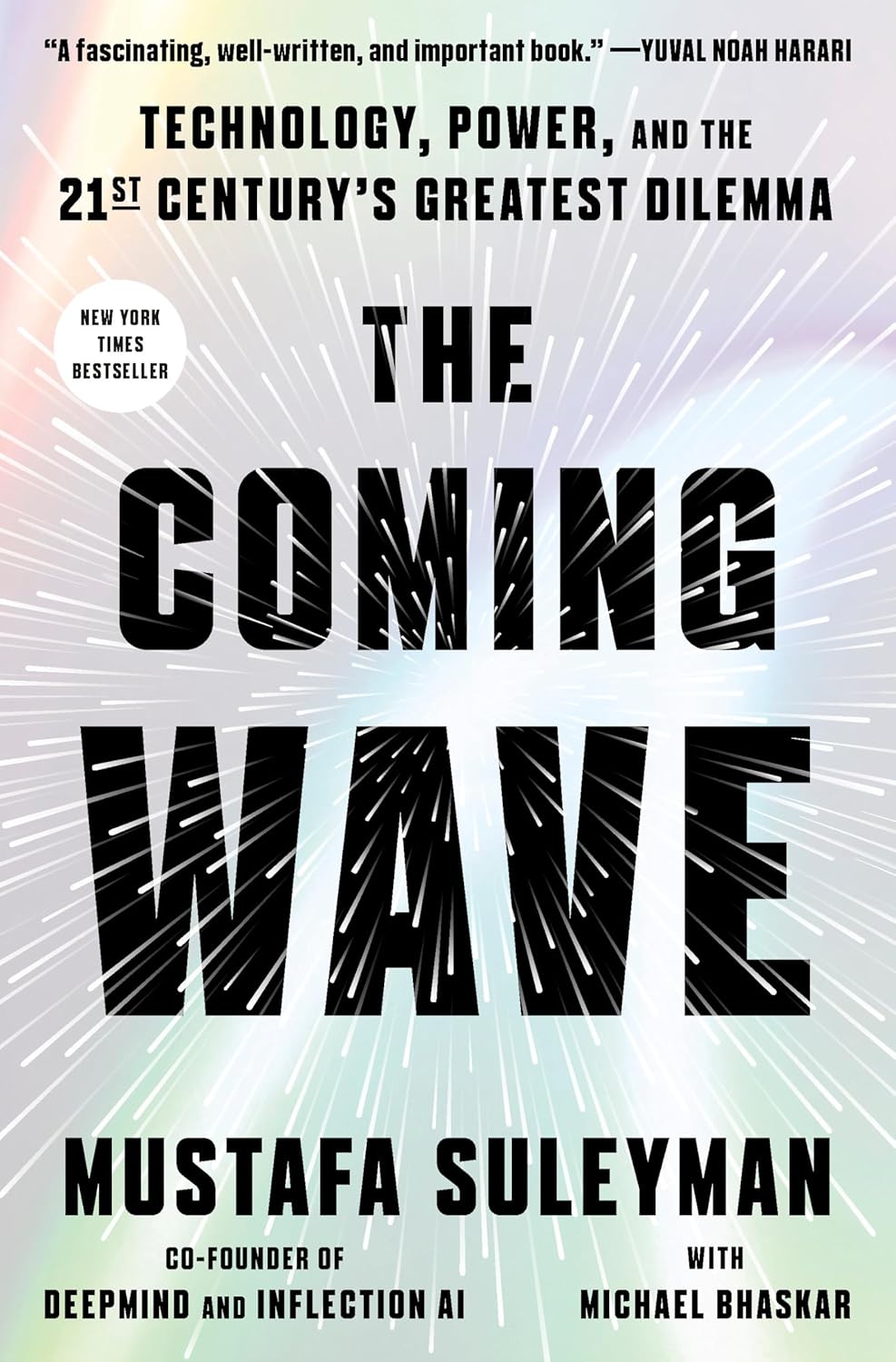
DeepMind co-founder on the dilemma of containing technologies that do not want to be contained.
As an Amazon Associate, Zendoric earns from qualifying purchases; the price does not change for you. · all our recommended books →
🔗 Related on Zendoric